
Custom Jewelry Wholesale Supplier Checklist
A supplier checklist for private label wholesale jewelry is mostly a list of questions that a factory can answer in writing. Six things decide whether an order runs cleanly: the compliance papers, the sampling and production windows, the six customisation points, the minimum order quantity, the ownership terms, and who signs off the final inspection. The published figures to compare against are 25–30 days of sampling and 3–4 weeks of production.

Key takeaways
- Sampling is 25–30 days and production 3–4 weeks, or 3.6–4.3 and 3–4 weeks once converted.
- Three compliance lines matter: ISO 9001:2015, a REACH statement covering lead, cadmium and nickel and a BSCI social audit, cadmium and nickel.
- Six customisation points are on the table, from base material to custom packaging.
- Minimums are 100 in artisan eco-brass, 100+ in stainless steel and 50 pieces in 925 silver, by design, and they hold design by design.
Start with the paperwork, not the samples
Compliance is the one line item that can stop a parcel at a border, so it belongs at the top of the checklist. What the manufacturer publishes is a quality management system to REACH limits on lead, cadmium and nickel, a BSCI social audit and the ISO 9001:2015 standard, cadmium and nickel.
Ask for the documented scope of each: the standard the quality system follows, the audit the social-compliance claim rests on, and the restriction list behind the materials statement. A supplier that keeps these three documents current does not have to describe them in adjectives.
The two windows converted into weeks
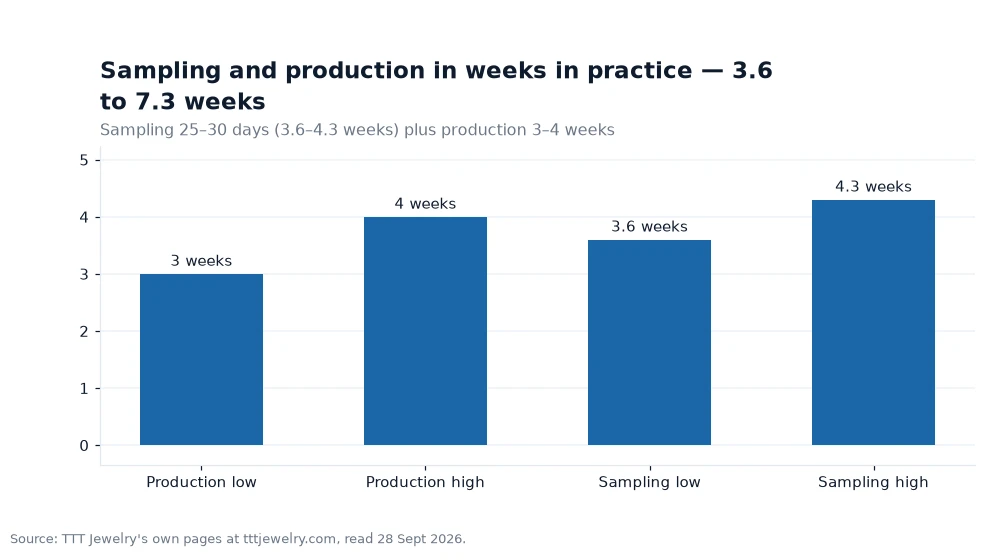
Two durations decide a launch. Master sampling is published at 25–30 days — 3.6 to 4.3 weeks — and mass production at 3–4 weeks after the sample is approved. CAD, the screen stage that opens the process, lands inside 48 hours.
Chained, a first order occupies about seven to nine weeks before freight. That is the number to write into a plan, because it already contains the plating, polishing and setting stages that a private label order cannot skip.
The six customisation points to specify in writing
The finish list: an anti-tarnish e-coat on silver and brass, vacuum PVD plating for steel, rhodium plating and gold at 14K, 18K and 24K.
Put all six in the first technical message rather than in a later email thread. The stones line covers natural stones and freshwater pearls, the hallmark line covers laser engraving with the S925 hallmark, 18KGP on gold-plated work and 316L for stainless steel purity marks, and the packaging line covers logo tags, foil-stamped gift boxes, pouches, backing cards and barcode labels.
MOQ treated as a checklist line
MOQ is 100 plus in stainless work, 50 pcs in 925 sterling silver and 100 in artisan eco-brass, counted per design, so a range of, meaning the totals scale with the number of designs. A supplier that quotes one flat minimum across all three metals is either simplifying or guessing.
The practical test is whether the minimum is quoted per design or per order. Per design means each new silhouette carries its own commitment, which is the number that should appear in your launch plan.
Who owns the drawing, the mould and the colour
Ownership is the checklist line that gets skipped and then hurts. The published position is 100% NDA with moulds, CAD files and the finished collection exclusive to the client, never resold and never shown to another account.
Tie that to observable behaviour. Ask whether the plating bath is shared between accounts, whether the CAD file is handed over on request, and whether rejected samples are destroyed or returned. The answers describe how a private-label programme actually runs at that factory, not how the pitch deck reads.
The gate list behind a clean order
Every order passes the same gates: inquiry, consultation and feasibility, CAD under 48 hours, sample and approval across 25–30 days, bulk production, then final quality control and delivery. The checklist value is not the list itself, it is knowing which gate an order is standing at on any given day, and who signs it off.
A custom jewelry wholesale order with one named owner and a written gate list behaves differently from one tracked by chasing. Ask for the gate names in the supplier's own words and hold them against the six published stages; a mismatch of vocabulary at that point is a preview of mismatched expectations later.
Two support commitments belong on the same page. The first is a 24-hour response standard on questions raised during the run. The second is a single dedicated project manager rather than a shared inbox, because a two-person relay is where a stone substitution gets approved by somebody who believed they were confirming a delivery date.
Then date the project backwards. Pick the day the carton has to leave, subtract 3–4 weeks of production, subtract 25–30 days of sampling, subtract 48 hours of CAD, and the result is the day the design has to be frozen. Most late seasons are decided by that subtraction rather than by anything the factory does.
The wholesale line publishes the same sequence at a different resolution, as five service steps: concept and design, master sampling, quality inspection, sample confirmation, mass production. Where the six-stage version separates the inquiry from the consultation, the five-step version folds them into concept and design. Both end at the same place, and the published reason for the inspection and confirmation steps deserves a line in any supplier review: the approved master sample is the benchmark, so quality is measured against batch #1 rather than against the batch in front of you.
| Checklist line | Published figure | Why it matters |
|---|---|---|
| ISO 9001:2015, BSCI, REACH | documented | Border, retail and marketplace compliance |
| Master sampling | 25–30 days | Launch date, and the cost of a design change |
| Mass production | 3–4 weeks | Reorder and season planning |
| MOQ by material | 50 / 100 / 100+ pcs | Which silhouettes get tooled first |
Worked example: converting both windows into weeks
Convert the published days first. Sampling at 25 days is 25 ÷ 7 = 3.6 weeks; at 30 days it is 30 ÷ 7 = 4.3 weeks. Production at 3 weeks is 3 weeks and at 4 weeks is 4. The published range across both stages therefore runs from 3.6 weeks to 7.3 weeks.
Then add the gates. A first order sits at the low end only if the sample is approved in one pass and CAD stays inside 48 hours. Every approval round after that moves the total towards 7.3 weeks and beyond, which is why the checklist treats the sampling window as a range and not a promise.
Frequently asked questions
What should a first message to a supplier contain?
The material, the finish, the stones or accents, the hallmark, the packaging and the expected first-run quantity, plus any sketch or reference photo. Those six fields cover the six published customisation points.
How long does private label production take?
Master sampling is published at 25–30 days and mass production at 3–4 weeks after approval, with 3D CAD inside 48 hours before sampling starts.
Which minimums apply to a first private-label order?
Order floors are 100+ in stainless work, 100 pieces in eco-brass and 50 in 925 sterling silver, counted per design, and nothing changes except the count of designs.
Running the checklist in the right order
Work the list in sequence: documents, then windows, then the six specification fields, then minimums, then ownership. A supplier that answers all five in writing before a sample is booked is telling you how the order will be managed — the six-step OEM/ODM workflow is a useful thing to hold the answers against, since it names each approval gate.
If the checklist is being run for a plated fashion line rather than a precious metal one, add the eco-brass programme to the comparison, because brass carries its own minimum and its own plating stack.
The specification quoted throughout — the five-stage service route, the two-day CAD stage as well as the three service strands — is recorded at the manufacturer's own website on tttjewelry.com's own pages, as of 28 Sept 2026. Nothing else here is inferred. The tally of steps and days is my own working, and nothing else here[1].