
Process Control in Perfume Manufacturing: Five Recent Shifts
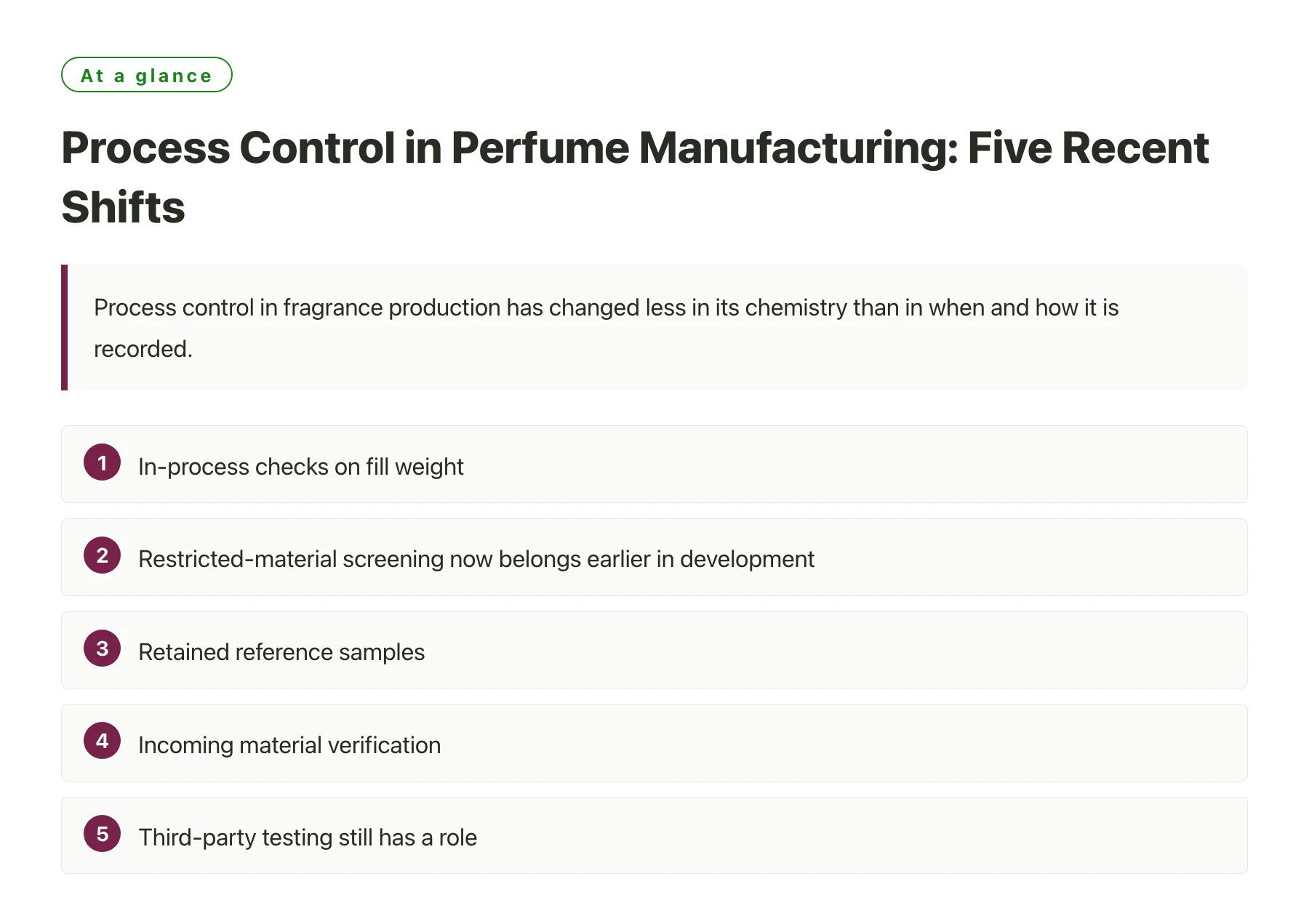
Process control in fragrance production has changed less in its chemistry than in when and how it is recorded. Checks that used to sit at the end of a run now happen during it, restricted-material screening has moved from review into development, and retained references have become a working tool rather than an archive formality. For a department store launch, those shifts matter because they are what make consistency across repeat orders demonstrable rather than merely asserted.
Key takeaways
- In-process checks on fill weight, alcohol content and appearance catch drift while a batch can still be corrected, unlike end-of-line inspection alone.
- Restricted-material screening now belongs earlier in development, so a formula is not approved before its limits have been checked [1].
- Retained reference samples, held under controlled conditions, are the mechanism that lets a reorder be compared with what was originally approved.
- Incoming material verification, including identity checks against a specification, is where the largest share of quality failures actually originates.
- Third-party testing still has a role, but it supplements a supplier's own controls rather than replacing them [2].
A brand commissioning a range is buying a process, not only a formula. The formula determines what the product should be; the process determines whether the tenth batch resembles the first. That distinction becomes commercial at retail, where a customer who buys the same scent twice expects the same experience both times, and where a retailer may audit the supplier on the strength of one complaint.
Discussions about quality often stall on certificates, which say that a system exists rather than what happens on a specific batch. The more useful conversation is about control points: where in the sequence a measurement is taken, what happens when it falls outside tolerance, and who signs off before the batch moves on.
The five shifts below describe how those control points have developed in recent years. They are also a fair description of what an experienced buyer now expects to see when visiting a production site.
How the control points have moved
The direction of travel has been consistent across the industry: control earlier in the sequence, evidence recorded as it is produced, and comparison against a retained reference rather than against memory. None of this is exotic technology; it is discipline applied at specific points. What has changed is how visible that discipline is to a buyer, and how much of it a retail launch now assumes.
From end-of-line inspection to in-process checks
Checking a finished batch tells you whether it is acceptable; checking it during compounding and filling tells you whether it can be corrected. Fill weight, alcohol content and appearance are now commonly verified at intervals through the run rather than only at the end, so a drift is caught while the batch is still in the line.
For the buyer, the practical question is what the tolerance is on each measurement and what the correction path looks like. A supplier that can describe both has a working control system; one that only describes the final inspection has a rejection system.
From restricted-material review to screening in development
The review of restricted materials used to happen late, sometimes as part of a safety assessment after a formula had already been chosen. It has moved forward, because a limit discovered after selection forces a reformulation and a new stability round. Screening candidates against published standards during development is now normal practice in export-oriented production [1].
This shift also changed what a buyer should ask for. Instead of requesting a conformity statement at the end, it is reasonable to ask which materials in a candidate carry limits and how much headroom remains in the intended application.
From retained samples to a working reference
Retaining a sample of an approved batch is an old requirement; using it systematically is newer. A reference held under controlled conditions, with a defined retention period and a comparison step at the start of each reorder, converts consistency from a claim into a procedure.
The distinction is visible in the questions a supplier can answer. How long is a reference kept, at what temperature, who compares a new batch against it, and what happens if the comparison is outside tolerance. Those answers describe a process; the absence of them describes an intention.
From supplier certificates to incoming verification
A certificate of analysis accompanies a material, but it does not prove the material in the drum matches the certificate. Identity verification on receipt, against a specification and a reference, is where a meaningful share of quality problems are prevented, and it is the control point most often examined during an audit.
This matters most for natural materials, where the same name can describe material of substantially different character depending on origin and processing. The verification step exists to catch that difference before it enters a batch.
Signals that process control is genuinely in place
Tolerances are stated as numbers
A supplier that describes its checks with figures, rather than as good or normal, is describing a system that can be audited and repeated.
Deviation handling is described without prompting
What happens when a measurement falls outside tolerance, who decides, and what is recorded. A supplier with a process answers this immediately.
References are stored, not just remembered
Retained samples under controlled conditions, with a retention period and a comparison step at reorder, are the mechanism behind batch-to-batch consistency.
Incoming materials are verified, not only received
Identity checks against a specification catch the substitution or lot change before it reaches a batch rather than after a customer complaint.
Packaging components are controlled too
Pump output, crimp quality and closure torque all change how a product performs, and they belong in the same control plan as the fragrance [3].
The last signal is the one most often left out of a quality discussion, because it sits outside the fragrance, but it decides how the product behaves in the hand. A pump that delivers slightly more per spray changes the impression of strength; a crimp that is not consistent changes leakage rates; a cap that does not seal changes how the top notes survive. Process control in a finished consumer product covers all of it, and the sequence described in any reliable account of how perfume is manufactured should include it.
What this means for a retail launch
A department store range is exposed in ways a direct-to-consumer drop is not. The product sits on a lit shelf for months, the same scent may be sold across several pack formats, and a single customer complaint can trigger questions from the retailer's own quality team. A brand that can produce a control picture, rather than a certificate alone, answers those questions in a single exchange.
The practical preparation is to ask for the control plan early, in outline rather than in detail, and to check that it covers three areas: the fragrance as compounded, the product as filled, and the pack as assembled. A plan that addresses only the first is common and incomplete.
It is also worth understanding what an independent laboratory adds. Third-party testing is useful evidence for a retailer and for the brand's own file, but it samples a point in time rather than monitoring a process [2]. The two are complementary, and a supplier that treats testing as a substitute for in-process control is describing a weaker system than it may appear to be.
When visiting or auditing a supplier, ask to see the control record for one recent batch rather than the quality manual. The manual describes an intention; a filled-in record with measurements, initials and a deviation note describes what actually happened. Two questions complete the picture: which measurements would stop a batch from moving forward, and who has the authority to release it anyway. A partner whose approach to quality control in luxury fragrance production is documented at that level will answer both without preparation, and that answer is more informative than any certificate listing.
Sources
- IFRA Standards Library (International Fragrance Association) —— The IFRA Standards Library lists the restrictions the fragrance industry applies to individual fragrance ingredients, based on safety assessments; it is the reference point for compliant fragrance formulation.
- SGS: Cosmetics, Personal Care & Household Testing —— Testing, inspection and certification services for cosmetics and personal care, including microbiological, stability and safety testing aligned with cosmetics GMP.
- Cosmetics & Toiletries —— A technical magazine for cosmetic formulators, covering ingredients, formulation science and testing methods.
Frequently asked questions
What is process control in perfume manufacturing?
It is the set of measurements and decisions taken during compounding and filling that keep a batch within specification, together with the records that prove it. It covers the fragrance, the filled product and the assembled pack, and it is what makes consistency across repeat orders repeatable rather than accidental.
Do certificates like ISO 22716 or GMPC guarantee a consistent product?
They evidence that a quality system is in place, which is a meaningful starting point, but they do not describe the behaviour of a specific batch. Buyers get more from asking to see a filled-in control record and the deviation procedure than from collecting certificates alone.
How can a brand check consistency between the approved sample and a bulk order?
Ask whether a retained reference from the approved batch is held under controlled conditions, for how long, and whether each reorder is compared against it before release. If a comparison step exists, ask what happens when the result falls outside tolerance.
Where do most quality failures actually start?
Frequently with incoming materials rather than with the process itself: a lot that differs from the specification, a substitution that was not flagged, or a natural material whose character has shifted with the harvest. Identity verification on receipt is the control that catches these before they enter a batch.
Does a department store audit a supplier differently from a direct-to-consumer brand?
Retailers often have their own quality expectations and may ask for evidence when a complaint is raised, so the documentation needs to be retrievable rather than theoretical. A supplier that can produce a batch record, a reference comparison and a deviation log quickly will handle the process with less disruption.